
In the previous article, I introduced the concept of metafunction in SFL. In this article, I would like to introduce the concept of register in SFL. However, it is important to understand that both concepts are interconnected. Metafunction describes the functions of language, while register is how the function is activated through the use of language variety based on the context of situation.
Defining Register
Register is the variability in language that depends on the context of situation, describing what is happening, who's involved, and how the communication takes place. It describes different ways to express the same meaning based on the immediate setting in which language is used to communicate.
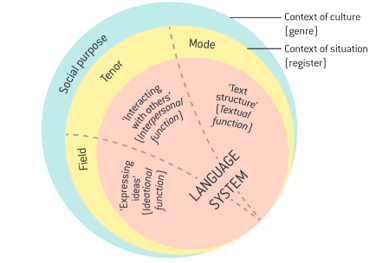
Register is not concerned with the correct form of language, but the approprate language use in context. We can also understand register as our lexicogrammatical choices based on what the language is used to talk about (field), with whom (tenor), and in what way (mode). Basically, these contextual variables resonate with metafunctions respectively.
Field
Field refers to what is happening in the situation, the topic, the type of social activity, the domain of the discourse, or the subject matter. It essentially answers the question: What is the text about?
Tenor
Tenor refers to the participants and the social relationships between them. It answers the question like: Who is taking part? What is the relationship like?
Mode
Mode deals with how language is being used. Ponder these question: Is the communication spoken or written? Is it planned or spontaneous? Is it face-to-face or mediated through text?
Closed and Open Registers
Register can also be closed or open. A closed register refers to the situation where the language is highly predictable and restricted by convention (e.g., airplane announcement). Meanwhile, open register refers to the situation where language use is more flexible.
Let's see register in action, based on the following examples:
- "I am writing to request further information regarding the scholarship."
- "Hey, can you tell me more about that scholarship?"
- "Tower, this is flight 302, requesting clearance for takeoff"
- "John, can you open the gate, please? I am ready to go."
- "Objection!"
- "Oh! I disagree with you on that point!"
If you pay attention, examples 1-2, 3-4, and 5-6 are about the same field. Examples 1-2 are about scholarship information; examples 3-4 are about requesting clearance; while examples 5-6 are about expressing an objection. However, they are expressed differently because the context of situation is different.
Example 2 is rather informal and perhaps spoken due to the close relationship between the participants (compare it with example 1, which is rather formal and written). Example 3 is an open register, informal in terms of tenor, in which the language used is flexible. Even with the same participants, the situation will be different when one is a pilot and one is the man in charge in the tower (like in example 3). Lastly, although examples 5 and 6 have a similar meaning, even with the same participants, example 5 will be used in the court, not example 6.
Register connects with metafunction in terms of realization. Ideational function is realized through field, interpersonal function is through tenor, and textual function is through mode. For more detailed discussion, consider to watch the following video: